
Stair Cladding
Wooden vs Concrete Cladded Stairs
Should I fit a concrete cladded stairs or a traditional wooden stairs in my home?
When considering fitting a concrete stairs in your new home or a traditional wooden stairs, it is important to consider your priorities.
Here at GreenHeart Wood Interiors, we can help guide you through your options, to help you make the correct choice tailored to your needs.
The main things to consider when choosing between traditional wooden stairs or cladded stairs are usually:
- Finish – traditional or modern
- Cost
- Sturdiness and acoustics
There are 3 main materials used in stair finishing:
- Wood
- Glass
- Metal
Without going into too much detail, a key factor when choosing between a concrete or wooden stairs is simply how much wood is being used in the finishing of the stairs.
In short, if the chief component in the finishing of your stairs is a wooden finish (painted or lacquered), then going with a timber stairs is the most cost-effective option.
The initial cost of a concrete stairs along with cladding the stairs with timber and subsequent painting, will leave the stairs much more expensive as a finished product.
However, if you are going with a more minimal, modern look, i.e., metal or glass balustrades and laminate flooring on treads and risers, a concrete stairs could be a more viable option for you.
If you are worried about the sound of people going up and down the stairs, a concrete stairs is more solid and will provide a lower acoustic level. However, if you are leaning towards a traditional timber stairs, you can counteract this by fitting a carpet runner down the stairs.

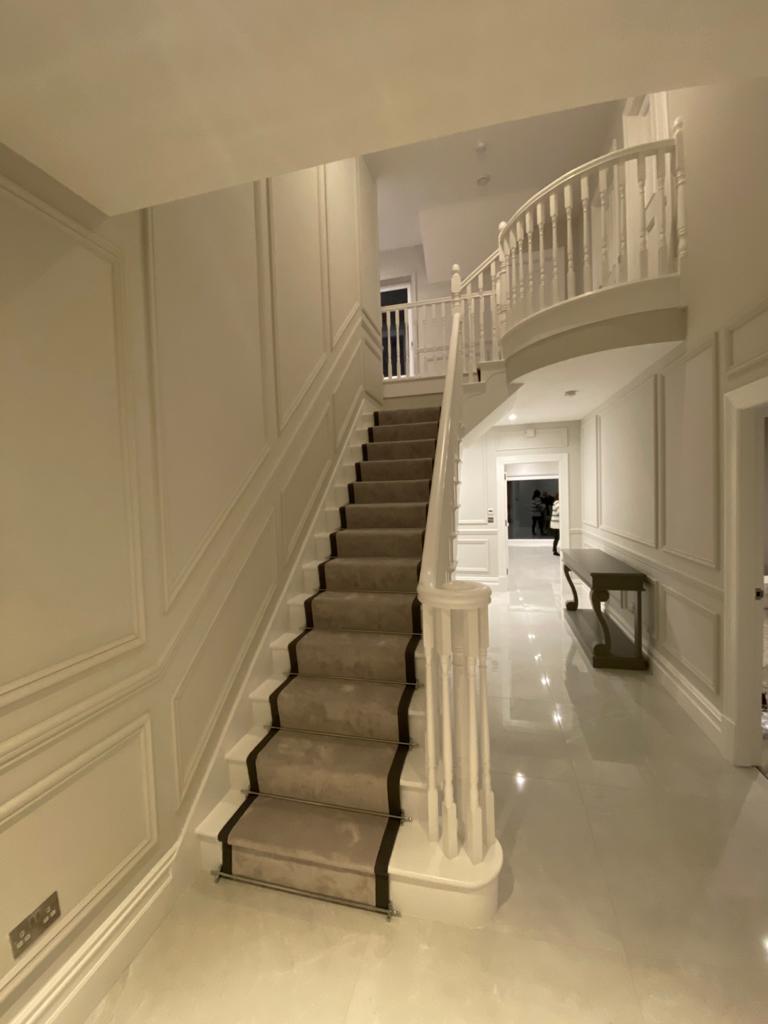
Picture here: Before and after cladded traditional timber stairs by GreenHeart Wood Interiors
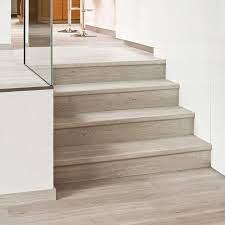
Picture here: Concrete stairs with laminate cladding available to view in GreenHeart Wood Interiors showroom
We have outlined the main advantages and disadvantages of both a concrete and a traditional timber stairs to help you with your decision.
Advantages and disadvantages of concrete stairs:
| Advantages | Disadvantages |
|---|---|
| Solid & sturdy | More costly specifically if cladding in traditional timber |
| Fitted early in build, temporary stairs not needed | Permanent structure, can be difficult to modify in the future in some cases |
| Fireproof | Cladding process is more time consuming onsite than wooden stairs, impacting access to upstairs by other trade workers |
Advantages and disadvantages of Traditional stairs:
| Advantages | Disadvantages |
|---|---|
| More affordable while achieving a high class finish, traditional or modern | Carries more sound (a carpet runner can counteract this) |
| Suitable for open plan stairs types | Temporary stairs required early in the build to access upstairs |
| Less time on site to install, avoiding delays to other trade work due to upstairs access restrictions |
In summary, if you are leaning toward a traditional stairs finish, a traditional wooden stair maybe the best option for you as the cost difference can be quite substantial. However, if you are looking for a more modern stairs finish, in particular when using laminate as a tread and riser, concrete cladding may be the way forward.
Whatever you decide, here at WSM supplies we cater to both cladded stairs and traditional stairs. We can also supply you with flooring, doors and panelling to complement your stairs. Contact us for a quote at [email protected] or on 046 9024883 or Find us on Facebook and Instagram.